
In physics, momentum reflects the mass and velocity of an object, how fast it’s moving and in what direction and how difficult it would be to stop.
In markets, momentum behaves similarly. When prices rise rapidly, they build positive momentum.
But when that force wanes, and the underlying participation fades, momentum deteriorates—often well before prices visibly turn.
Emotional forces drive market momentum. Hope and greed push rallies to unsustainable highs, while fear accelerates declines. Fear of missing out near market tops—and fear of loss near bottoms—are the emotional equivalents of thrust and gravity. Momentum analysis allows us to quantify those emotional undercurrents and identify when the prevailing trend is weakening, even as prices appear strong on the surface.
One good proxy for market momentum is the McClellan Oscillator. As it moves up into increasing positive readings it reflects successively higher positive momentum for stock prices. As it moves down, it reflects increasingly negative momentum for stock prices, with the readings becoming more negative.
When the McClellan oscillator rises to increasingly positive values, it signals accelerating upside momentum. As it reverses lower and crosses into negative territory, it indicates weakening breadth and growing downside force. This transition often occurs while headline prices are still climbing.
Tomorrow’s report will take a look at momentum behaves at critical turning points at three of the most significant Primary Cycle tops in modern market history—January 1973, September 2000,
This pattern —price advancing to marginal new highs while momentum weakens—has appeared at every major bull market since 1929.
In the final 10 days before each peak, the McClellan Oscillator repeatedly prints negative readings, signaling exhaustion beneath the surface.
July 2025 is the most extreme divergence yet.
From the October 2022 low through this week the SPX has stage a powerful rally.
Yet, in the last 10 sessions—four of which produced new all-time highs—the McClellan oscillator has been negative on eight of those ten days.
We have found no other instance since 1929 where such persistent momentum deterioration occurred while the SPX was setting record highs.
This does not guarantee that July 2025 marks the final top.
However, a final top should occur in 2025. My expectation is that a serious correction occurs before a last ditch rally because there is a lot of synergy with the 4th quarter.
But the market has surprised all those with experience
Experience often works against the most seasoned traders when the market is flying over the cuckoo’s nest.
From the 1929 peak on September 3 to the January 11, 1973 peak is 43 years, 4 months.
A total of 520 months.
From the major 1982 August low to July 2025 is 515 months.
December 2025 will be 520 months from August 1982.
That said we are in the 43rd year—1982 plus 43 years is 2025 so plus or minus a few months in the scope of 43 years
Is within bounds.
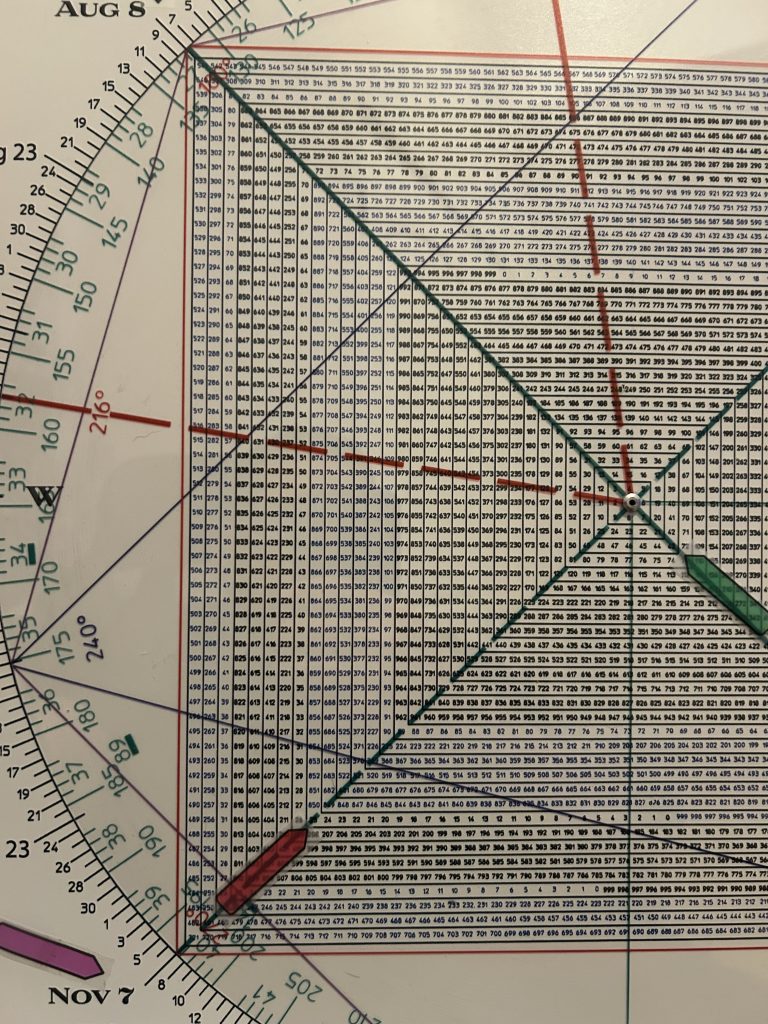
On the Square of 9 Wheel the number 43 is straight across and opposite August 8.
Amazingly 43 squares-out with 2025 …using that as a year.
The historic runaway blowoff in 1929 lasted 97 calendar days.
The 1987 melt-up was 95 calendar days.
Currently the runaway move from April 2025 is 112 days.
The 1987 last ditch run in the SPX was 22%
The DJIA run for the roses in 1929 was 33.
Currently the SPX is up 32.4% since the April low.
For the moment, the SPX potential 6410 square-out region is exerting its influence with a high and a reversal into the red from a high of 6401 on Monday.
Be that as it may, the runoff saw the index rally into the green…again…backtesting Monday’s Opening Range Break.
After the bell CDNS and CLS ripped after reporting.
So animal spirits may take the bull by the horns again in the early going.