
“But I am just a monkey man” The Rolling Stones, Monkey Man
“Whom the Gods would destroy, they make first to identify an asset bubble.” Clifford Asness
Our job is not to bet the farm on a forecast or a roadmap; it is to watch how the market responds to these forecasts.
Mike Tyson said it perfectly: “Everyone has a plan until they get punched in the mouth.”
The market can do anything. Our job is to play the odds, and believe what we see until proven otherwise. Those who like to think they are brilliant students of finance and markets may not like to hear this, but those who make consistent money in the markets act like good monkeys dancing to the music of Mr. Market, the organ grinder.
Words we need to live by that you should put on a post- it in your office:
SPECULATION IS OBSERVATION—pure and experiential. Thinking isn’t necessary and often just gets us in trouble.
Many traders overthink aspects that don’t provide market direction. They end up more confused than anything else.
Concentrate on direction. The Line of Least Resistance.
That is why I analyze cycles and come up with the most likely fit. Because it is not the rationale or the why but the when that counts.
Don’t tell me what or why the market is going to do something, please just tell me when.
As the legendary W.D. Gann stated over and over again, “Time is more important than price.”
So what I want to do in this piece is take a overview of how Gann looked at price.
First and foremost, Gann said to key off the weekly charts.
This is why I developed the Swing Method based on the 3 Week Chart.
The arrays of long term cycles drive the big picture but as traders we must live die by the short-term weekly cycles. Because the larger cycles can “right and left translate”, i.e., they can be off by months. That can hurt us.
Gann never specifically “gave away” in detail what he was doing.
He was obtuse and cryptic. So much so that when he was crystal clear, traders doubted it was important. Gann knew what he was doing in more ways than one.
Why was he cryptic? Two reasons, traders paid up to $5,000 dollars for his instruction and courses in the 1930’s—the price of an average home at the time.
Why would he just put all the pieces together in his books, as valuable as they are.
As well, Gann was a very religious man and believe we should be seekers to make any endeavor meaningful.
Before we get into how Gann looked at cycles and Time, I want to say that Gann stated that years ending in “5” were Bull Years. He called them the year of ascension.
For example 1975, 1985, 1995, 2005, 2015 and 2005.
1975 was a rally year. It followed a major bottom in Oct/Dec 1974.
1985 was a bullish year continuing from the major low in 1982.
1995 the market exploded in a 5 year bull run to a major top in Q1 2000.
2005 the market went flat. No “ascension”.
In 2015 the high of the year was in February with a deep selloff starting in August and lasting into February 2016, a major low.
So the last two years ending in 5 were NOT strongly bullish.
This is the third year in a series of two lack-luster years ending in “5”…the second, 2015, worse than the one before 2005.
That may translate into the 3rd in the series (markets tend to play out in three’s) being bearish.
So if 2025 has marked a high in January punctuated by a last weeks massive Breakaway Gap and rolls over in February, we have an indication that 2025 is going to be a “year of descension.”
The fact that the SPX already hinted at this by triggering our December Indicator…closing under the December low (December 20) in January (on January 10) is a warning, albeit it was a one day warning.
The bottom line is we must pay attention when the market does something it shouldn’t do:
When the market starts to go down in a year ending in “5”, it usually means it’s not going to be a rally year, and it may be an outright bearish year.
In either eventuality bull year or bear year we will be updating the cycle analysis as observed going forward.
At this juncture, bull or bear, the presumption is a decline into March.
What we really need to pay attention to is cycle lows. When cycles point to lows they most often define buy points. When cycles point to highs, they can be something altogether different.
Why? Because the Trend is up. Most of the time the bias is to the upside. Hence, unless you get a confluence and cluster of several cycles saying “top” then one or two cycles pointing to a high may just define a resting place, a consolidation.
This in and of itself tells us a lot about the complexion of the market at any given juncture.
You see, cycles are far more reliable in foretelling market buy points. Full stop.
With that in mind, let’s look at an overview of how Gann looked at Time.
What does Gann really mean when he famously said, Time is more important than price.”?
It means that when time is up, the trend turns, no matter how strong or how weak the market or individual stock has been.
Succinctly, Time Turns Trend.
There are two ways in which this occur as there are two kinds of cycles: Time cycles or natural cycles, seasonal cycles and cycles derived from the markets own significant price highs and lows.
Both of these cycles will have important divisions on 1/8, 1/4, 1/3, 3/8, 1/2 , 5/8, 2/3 , 3/4 and 7/8.
Accordingly Gann’s Master 60 Year Cycle will be divided into important probable turning points as follows:
1/8 = 7.5 years. This ties close to 7 years and the natural cycle of 360/365 weeks.
As Gann stated 7 is the number of time. There are 7 days in a week and f52 weeks in a year. Consequently 52 X 7 = a natural circle of cycle of of 360 weeks with 365 being the number of days in a year.
Wheels Within Wheels. Time is not linear but follows a logarithmic PROGRESSION.
This is why cycles work.
1/4 = 15 years
1/3 = 20 years, Gann’s Time Factor.
So here we have the triangle of 20 years within the 60 year circle or cycle and the saquare of 15 years on each ‘side’ of the 60 year cycle.
This is why Gann’s logo was a triangle and a square within a circle.
W.D. Gann’s use of Natural Law and geometric proportion is based on the circle, square and triangle are as undeniable and effective today in the stock and commodities markets as they were while he was alive.
Let’s look at a few examples.
From the 1980 low (the price low was 1980, 1982 was a higher low) a 20 year cycle played out into the March/August Primary and Secondary Tops.
Was that an important top?
Yes. The NAZ dropped 76.8% into October 4th 2002 mirroring the DJIA Bear decline into 1932, seventy panic years earlier.
The 2002 came 20 years after the 1982 low perpetuating a 5 year runup into 2007.
Anniversary dates were very important for Gann as they represent a Solar Return.
Notice that the anniversary date of October 4th 2002 and the October 5th, 1990 low, 144 Fibonacci months apart—12 years, mirroring the 12 months in a year.
Wheels Within Wheels.
In sum, some traders only use price. Some traders use cycles…time.
Few know how to integrate Time and Price.
Master trader W.D. Gann wrote that when Time and Price square-out (meet or balance out) expect a change in trend.
That is what my Square of 9 Time & Price Calculator does.
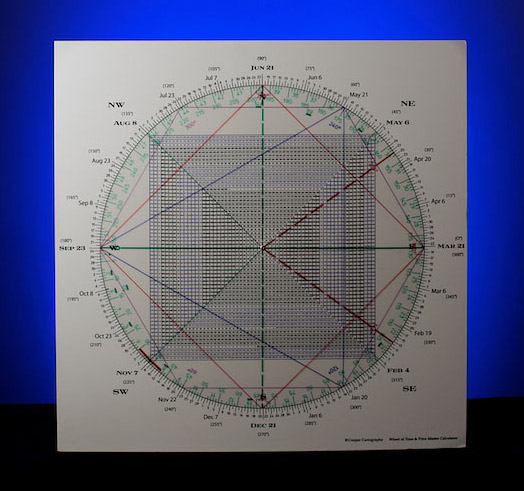
Square of 9 Wheel
Purchase your own Square of 9 Wheel. Shipping to US only. Contact Jeff for shipping outside the US.
Monday’s report, If You Understand Cycles You Can Time Big Moves In the Market will delve further into how to integrate time and price.
Timing is key, but without risk management it is nothing.
How does one best manage position sizing on a setup?
There have been countless books written about position sizing.
Ultimately this becomes a matter of how many stocks you are holding at any given time.
I have developed a 3 pronged approach to the market over a 40 year trading career.
I am an active short term/intraday trader, hence my newsletters name, The Hit and Run Report after the books I wrote on short term trading in the late 1990’s
I am also a swing trader which means positions are typically intended to be held for 3 to 5 days— I say intended because one a stock comes out of a pattern or pivot point, it it runs up my swing method is to sell one-third to one-half and trail a protective stop on the balance.
Sometimes the trailing stop is breakeven but if the stock explodes it may be higher and sometimes that trailing stop may be hit the same day or the next day.
I am also a position trader which means I may hold a position for weeks or months.
Generally the size of your positions should be determined by how much equity you stand to lose if a trade goes against you.
This also involves correlation risk.
In other words typically I may have 10 swing positions and perhaps 5 longer term positions.
If 5 of my swing positions are semi-conductors I have correlation risk because typically they will move together.
I traffic in growth names for the most part and these can be high beta stocks with a lot of volatility so my position sizing will also depend upon how many high beta stocks I have.
As a rule of thumb let’s assume a $100,000 account devoted to a swing portfolio.
As offered before I think in terms of 10 swing positions although sometimes I may have as few as 3 and sometimes I may have 10.
But as a rule of thumb with a 100,000 account that means I don’t want any one swing position to be more than 10% of the account or $10,000.
Assuming a $50 stock that means 200 shares.
As an active trader, in the heat of the battle, I don’t calculate exactly how many shares my 10% position is going to be. Moreover I often build a position by taking a pilot starter position and go from there keying off the tone of the market and the stock’s own intraday behavior.
I will typically risk no more than 4% in any one position.
In this example that is $400. Since I’ve bought 200 shares that represents a stop of 2 points.
This is my uncle point, or fail safe stop. My initial stop may actually be less because it is determined by the stocks own pattern and pivot points, its own intraday relative strength or weakness and the overall market tone that day.
I am more of a pullback buyer than a breakout buyer.
If I’m buying a pullback or a pivot then my risk is going to be limited so in reality my stop may be 1%.
This allows me to do two things: my initial position size can be larger and I can build a larger position if the stock moves in my favor.
In other words my position sizing is going to reflect my risk to reward.
If I’m buying in a pullback I may be able to take a larger position because my expectation is that I’m buying support so my stop is much tighter.
In other words I can take a larger size with a tighter stop whereas if I’m buying a breakout I may start with smaller size and build because as I learned from Bill O’Neil around 50% of all breakouts will check back or backtest the breakout pivot.
In other words the first mouse gets the squeeze and the 2nd mouse gets the cheese.
The first move out often squeezes players while the next move often is the real deal.
To recap, as to swing trades I divide my account into 10 swings but on any given day I could have 1 or 10 swings
the longer term bigger picture positions are outside of this portfolio and I leverage my account against the equity in these bigger picture positions.
I handle my day trades in the same way as my swing trades and these are levered against my longer positions as well but I am out by the end of the day so I’m not on margin in that respect. To be honest, in a fast market, I think in terms of X number of shares and know where my stop is—versus calculated position sizing— and if the stock doesn’t follow through I may get out quickly because when I bought it I bought because I expected it to move.
If it doesn’t I may exit.
So I often think in terms of X number of shares as to day trades because I’m not positioning them and the time factor gives me less exposure.
What no one really tells you which to me is key to sizing is a daily analysis of the market itself.
More than anything this will determine whether my positions will be small medium or large.
In other words it is the tone of the market that day, is it a trend day is it a chop day or could a reversal day be on the table.
So my position size is determined by where my risk is.
My risk may be tight as in a pullback or a flat or larger on a breakout in which I will buy fewer shares and build or average up.
In a strong trend day with a stock already in motion, I will take a pilot position and often add on an intraday pullback.
So I will build a position based on the characteristics of the stock, its position and its beta or volatility and market tone.
Most everyone will tell you not to have too concentrated a portfolio– in other words not to have just a few stocks in a portfolio.
I agree this is a risky proposition for newer traders but for experienced traders this is how wealth is built.
A concentrated portfolio is something I may do with first stage breakouts or late stage breakouts.
The biggest moves in the shortest period of time usually come at the end of moves—buying into climax runs…the Pain Trade.
In other words diversification is safe but can be too counterproductive.
I like to put it this way —I day trade and swing trade for cash flow and for income, but for wealth building, once you have experience, I take larger than normal size with 2 to 4 positions in a campaign
The trick of the trade is to find a balance between position size and a stop which is based on the stocks personality or volatility.
For a swing or a longer term position trade you want to allow a stock to fluctuate without choking off the trade prematurely.
This comes with observing the market and a stocks behavior and getting to know the personality of a stock.
As I said above, speculation is observation pure and experiential. Thinking isn’t necessary and often just gets in the way.
In my experience it is this observation from my turret every day that allows me to intuit my position size.
This is the tension between a strict discipline and the intuition and judgement that comes with experience like any profession.
As George Soros says, “I’m only rich because I know when I’m wrong.” He didn’t say I’m only rich because I use such and such formula.
If you know when you’re wrong you can take a larger than average position size.
There are tons of rules in countless books about position sizing.
The 10 most important rules are
1) Bet high enough to make meaningful profits when you win
2) Bet low enough so that you are ok financially and psychologically when you lose
3) Rule # 3 is don’t create another 7 rules that don’t work just to have 10 rules.
Trading for cash flow and income is one thing for wealth building, you want to bet like a pig when you see something really exciting when the stars align…such as we did with the metals (again) on Wednesday, January 29th.
I have a real respect born of fear of the markets.
I saw my dad lose more money than he had to his name in one day in the markets when I was 12 years old.
My dad came back, taking 3 times out of the market than he lost and retiring.
He was gifted with an exceptional drive. He was tough.
My fear of the markets forced me to hone by timing and stock picking with precision.
In the markets it takes fear to induce respect.
In my experience, in this game, only the humble survive.
I learned you don’t play macho man with the market and to respect risk.
You may think you are in charge, but without respect for the markets you will be in charge like General Custer.
Markets can turn on a dime; most traders cannot.
My breakthrough came in the early 1990’s.
I was fortunate to meet someone who had amassed a fortune short term trading.
But he had no rules he could explain.
He told me how when he would trade at home, he’d watch the sparrows in his garden.
When he’d feed them bread, they’d take just a little piece at a time and fly away.
They kept on flying back and forth taking small bits of bread.
They may have to make a hundred stabs at a piece of bread to get what a pigeon gets at one time.
But that is why a pigeon is a pigeon.
You will never be able to shoot a sparrow. It is just too fast.
That was the beginning of my quest to create a rules based strategy keying off pattern and multiple time frame analysis, what I called the Hit & Run Methodology.